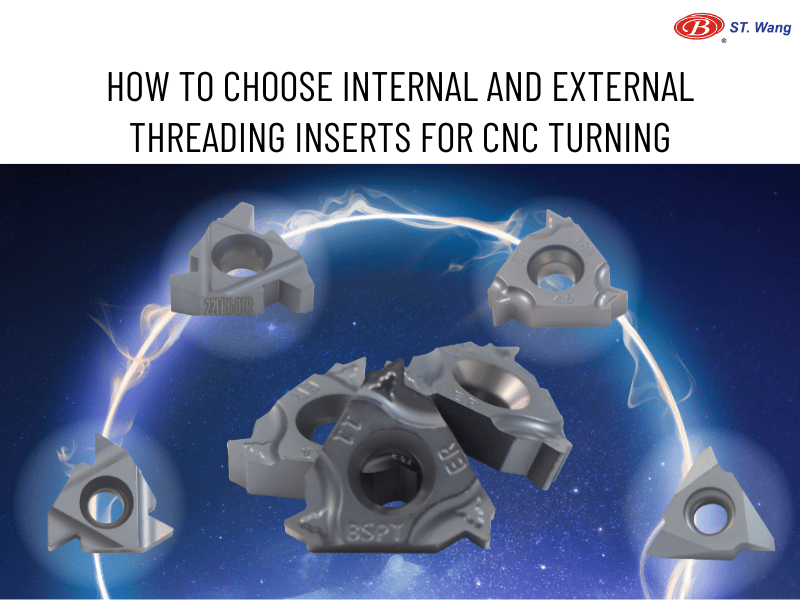
How to Choose Internal and External Threading Inserts for CNC Turning
Threading is one of the most critical operations in CNC turning. Whether machining internal threads for hydraulic components or external threads for shafts and fasteners, the choice of threading inserts directly affects thread accuracy, surface finish, tool life, and overall production efficiency.
Unlike tapping, CNC threading with inserts offers greater flexibility, higher repeatability, and better control—especially in hard materials, large diameters, or mass production. This article provides a practical guide to selecting internal and external threading inserts for CNC turning applications.
Why Threading Inserts Matter in CNC Turning
In CNC lathes, threading inserts allow precise control over:
- Thread pitch and profile
- Cutting depth and pass strategy
- Tool wear and dimensional consistency
Compared with taps, threading inserts are less prone to breakage, easier to replace, and suitable for a wider range of materials and thread standards. This makes them the preferred solution for modern CNC turning operations.
Internal Threading Inserts: Key Considerations
Internal threading inserts are used to machine threads inside a bore, such as nuts, pipe fittings, and hydraulic parts. While versatile, internal threading presents unique challenges.
Common Challenges
- Limited space inside the bore
- Chip evacuation difficulties
- Reduced tool rigidity due to long overhang
Selection Tips
- Minimum bore diameter: Ensure the insert and toolholder fit the internal diameter safely.
- Insert geometry: Choose appropriate rake angles and chipbreakers to improve chip control.
- Full profile vs. partial profile: Full profile inserts ensure correct crest and root dimensions, ideal for production runs.
Internal threading inserts are especially effective when machining stainless steel, alloy steel, or deep internal threads where tapping is unreliable.
External Threading Inserts: Key Considerations
External threading inserts are used for machining threads on shafts, bolts, and cylindrical components.
Advantages
- Higher tool rigidity
- Easier chip evacuation
- Better visual inspection of thread quality
Selection Tips
- Thread standard: ISO, UN, NPT, BSP, and other profiles require specific insert geometries.
- Surface finish requirements: Insert edge quality and coating play a major role.
- Production volume: Full profile inserts are recommended for consistent mass production.
External threading inserts are widely used in automotive, machinery, and industrial fastener manufacturing.
Internal vs. External Threading Inserts: A Practical Comparison
| Item | Internal Threading Inserts | External Threading Inserts |
|---|---|---|
| Machining location | Inside bore | Outside diameter |
| Tool rigidity | Lower | Higher |
| Chip evacuation | More challenging | Easier |
| Typical applications | Nuts, pipe fittings, hydraulic parts | Shafts, bolts, fasteners |
| Skill requirement | Higher | Moderate |
Choosing Insert Geometry: Full Profile vs. Partial Profile
- Full Profile Inserts
- Machine the complete thread shape in one process
- Ensure accurate crest and root dimensions
- Ideal for mass production and strict tolerances
- Partial Profile Inserts
- More flexible for different pitches
- Require additional passes to control thread depth
- Suitable for small batches or custom threads
For high-volume CNC turning, full profile threading inserts are generally the most efficient choice.
Material Matters: Matching Inserts to Workpiece Materials
Different materials require different insert grades and coatings:
- Carbon steel: General-purpose carbide grades with TiN or TiCN coatings
- Stainless steel: Tough carbide grades with TiAlN or AlTiN coatings
- Alloy steel: Wear-resistant grades with stable edge geometry
- Cast iron: Hard grades optimized for abrasion resistance
Correct grade selection significantly extends tool life and stabilizes thread quality.
Common Threading Problems and How to Avoid Them
- Chipped thread edges: Improve rigidity, reduce overhang, adjust cutting parameters
- Poor surface finish: Select sharper insert geometry or suitable coating
- Rapid insert wear: Match insert grade to material and avoid excessive heat
- Inconsistent thread size: Use full profile inserts and stable CNC programming
Why Work with a Professional Threading Insert Manufacturer
At SHANG TZANG WANG ENTERPRISE CO., LTD. (享展王企業有限公司), we manufacture a complete range of internal and external threading inserts designed for CNC turning applications. Our product lineup supports various thread standards, materials, and production requirements.
Beyond manufacturing, we assist customers with:
- Insert selection guidance
- Cutting parameter recommendations
- Application-specific solutions for stable mass production
Conclusion
Choosing the right internal and external threading inserts is essential for achieving reliable thread quality and efficient CNC turning operations. By understanding machining conditions, material properties, and insert geometry, manufacturers can significantly improve productivity and reduce tooling costs.
As a professional cutting tool manufacturer, SHANG TZANG WANG ENTERPRISE CO., LTD. is committed to supporting manufacturers with high-quality threading inserts and technical expertise. For further details or application support, we welcome you to
for professional assistance.