How to Choose Turning Inserts: Advanced Selection Strategies for Better Productivity
Choosing the right turning insert goes beyond selecting a shape and size — it directly affects tool life, surface finish, cycle time, and total machining cost. While our previous guide introduced the fundamental insert classifications and ISO nomenclature, this article goes a step further. Here, we explore advanced factors that professional machinists must consider to optimize performance in real-world production.
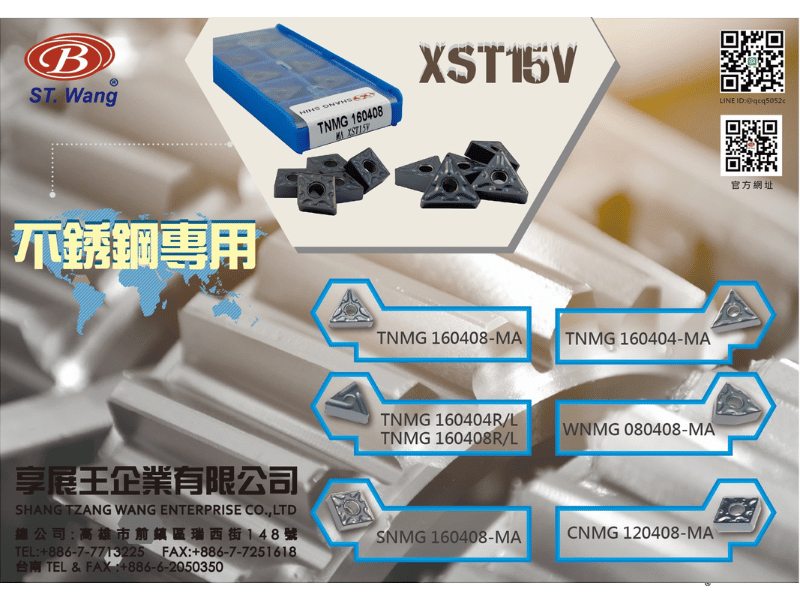
At SHANG TZANG WANG ENTERPRISE CO., LTD., we provide turning inserts designed for stainless steel, cast iron, and general steel machining — enabling customers to achieve stable, cost-effective turning results in both CNC mass production and precision machining applications.
1. Material First: Selecting the Correct Insert Grade
Different materials demand different carbide compositions and coatings:
| Workpiece Material | Recommended Insert Features |
|---|---|
| Stainless Steel (S) | High toughness insert, sharp cutting edge, anti-built-up coatings (e.g., TiAlN, AlTiN) |
| Cast Iron (K) | Hard-wearing carbide, strong edge geometry for abrasive materials |
| Carbon/Alloy Steel (P) | Balanced toughness and wear resistance, optional chipbreaker depending on depth of cut |
| Super Alloys (M, S) | Heat-resistant coatings, optimized chip control for high temps |
Tip: When machining stainless steel and cast iron, using dedicated insert grades greatly increases insert life.
2. Chipbreaker Style Determines Cutting Stability
Chip control is mission-critical. Poor chip evacuation causes vibration, high heat generation, and even insert breakage.
| Operation Type | Best Chipbreaker |
|---|---|
| Finishing | Sharp, low-force cutting geometry |
| Medium Cutting | All-purpose balanced breakers |
| Roughing / Interrupted Cuts | Strong edge, higher chip-curling pressure |
Conclusion: Choose chipbreaker based on cutting depth, feed rate, and surface finish requirements.
3. Choose Insert Nose Radius Based on Tolerance & Rigidity
| Nose Radius | Primary Benefit | Best Use |
|---|---|---|
| Small (0.2–0.4 mm) | Low cutting forces, better tolerance | Finishing, thin-wall parts |
| Medium (0.4–0.8 mm) | Versatile performance | General turning |
| Large (1.2 mm ↑) | Stronger tip for roughing | Heavy cuts, unstable setups |
Rule of thumb: Better finish? → Small radius. Maximum strength? → Larger radius.
4. Depth of Cut + Feed Rate Must Match Insert Geometry
| Issue | Cause | Solution |
|---|---|---|
| Excessive wear | Too shallow DOC | Increase DOC to engage chipbreaker |
| Chatter | Feed too light | Increase feed or use smaller nose radius |
| Breakage | DOC too heavy | Use a stronger insert shape & thickness |
Tip: Weak setup or long overhang → use stronger insert shapes like C, D, or W.
5. Coating Selection Can Make or Break Tool Life
| Coating | Best For | Benefits |
|---|---|---|
| TiN | Low carbon steel | Basic wear resistance |
| TiAlN / AlTiN | Stainless steel, alloy steel | High heat protection |
| AlCrN | Abrasive materials | Top-tier wear resistance |
| Uncoated | Aluminum | Avoids built-up edge |
Conclusion: For stainless steel and cast iron, coating performance is significantly better than uncoated inserts.
Focus on Cost per Component, Not Insert Price
- Cheap inserts may increase overall production cost
- More tool changes → more downtime
- Lower cutting stability → higher scrap rate
Smart selection = lower cost per finished part + higher productivity
Why Choose SHANG TZANG WANG Inserts?
- Specialized grades for stainless steel & cast iron
- Stable cutting performance in long-run CNC production
- High efficiency under higher feed rates
- Custom insert geometries available
- Technical support for parameter optimization
Contact us for engineering support — send us your material, depth of cut, feed rate, and tolerance requirements, and we’ll recommend the best insert solution for your machining.
Conclusion
Choosing the right turning insert requires a strategic approach — matching material, chipbreaker style, coating, nose radius, and cutting parameters. When optimized, turning performance will reach its full potential with measurable improvements in:
- Tool life
- Cutting stability
- Surface finish
- Production cost
Let SHANG TZANG WANG ENTERPRISE CO., LTD. help you get the best performance for every cut.